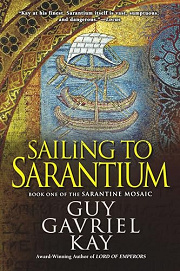
Sailing to Sarantium by Guy Gavriel Kay

A master mosaicist is summoned to a glittering imperial capital where art, politics, and prophecy interlock like tesserae in a grand design. Lush, humane, and quietly breathtaking, Sailing to Sarantium draws you into a world where a single work of beauty can alter the course of an empire.

Have you read this book? Share what you liked (or didn’t) and get personalized recommendations.

Start or resume Shelf Talk

Love Sailing to Sarantium but unsure what to read next?

These picks are popular with readers who enjoyed this book. Possible spoilers below.

In Sailing to Sarantium, did you enjoy the knife‑edge court maneuvering around grand imperial projects and factional loyalties?

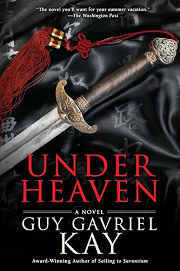
Under Heaven by Guy Gavriel Kay

If you loved following Crispin’s careful steps through Sarantium’s court—balancing the Blues and Greens, imperial favor, and the peril of a commission on the Great Sanctuary’s dome—then you’ll savor how Shen Tai’s unexpected gift of horses upends the balance of power at the Tang‑inspired court of Kitai in Under Heaven. The same elegant tension between artistry, patronage, and politics drives every scene, with dazzling rituals, ambitious ministers, and a ruler whose smile can be as dangerous as a blade.

In Sailing to Sarantium, did you enjoy a reimagined history where subtle, uncanny magic entwines with real political power?

Jonathan Strange and Mr Norrell by Susanna Clarke

In Sailing to Sarantium, hints of the sacred—and the way the cult of Jad inflects court and city—give Crispin’s journey a numinous edge behind the palace games. Jonathan Strange & Mr Norrell offers that same sense of a recognizable past reshaped by the uncanny: cabinet rooms, generals, and kings jockey for advantage as magic returns to England. If navigating Emperor Valerius’s city thrilled you, watching magicians bend nation and narrative will, too.

In Sailing to Sarantium, did you enjoy meticulous cultural and religious worldbuilding that dictates politics at every turn?

City Of Stairs by Robert Jackson Bennett

The texture of Sarantium—its processions, mosaics, and rituals, the Blues and Greens, the shadow of old gods beneath Jad—imbues Crispin’s choices with weight. In City of Stairs, the conquered city of Bulikov bears the scars of dead divinities; laws, architecture, and memory all warp around theology. If the layered customs and sacred spaces of Sarantium captivated you, Shara Komayd’s investigation through banned histories and divine remnants will scratch the same itch.

In Sailing to Sarantium, did you enjoy lush, lyrical prose that makes an old‑world city—and its artisans—feel vividly alive?

The Golem and the Jinni by Helene Wecker

If you were entranced by the luminous descriptions of Crispin setting tesserae under Sarantium’s light, the hum of workshops, and the city’s living pulse, The Golem and the Jinni offers similar magic in 1890s New York. A golem and a jinni move among tinsmiths, bakers, and glassblowers in prose as rich and precise as mosaic work, turning craft and place into something wondrous and intimate.

In Sailing to Sarantium, did you enjoy a patient, layered unfolding of courtly schemes shaped by the hand of the divine?

The Curse of Chalion by Lois McMaster Bujold

Crispin’s path to Sarantium—letters of passage, wary audiences, and a commission freighted with religious meaning—unspools with deliberate, rewarding momentum. The Curse of Chalion likewise builds slowly as Cazaril returns to court service, maneuvering through marriages, succession crises, and a living theology that intervenes at a terrible price. If that measured ascent through danger toward grace worked for you, this will, too.